
Last Updated 3 weeks ago by Emily Standley-Allard
The fall equinox marks one of the year’s most powerful seasonal thresholds, when summer’s outward expansion begins giving way to autumn’s quieter turn inward.
It is an expressive, outward-facing season, abundant with light and alive with movement. The days stretch late into the evening, inviting us beyond the walls of our homes and the boundaries of our usual routines. We travel, gather, wander, celebrate and spend more time beneath the sun, collecting experiences almost as naturally as gardens collect heat. There is something about summer that encourages visibility. We participate more fully in the world around us, and perhaps allow more of the world to see us in return.
Then, almost imperceptibly at first, the current begins to change.
The evenings arrive a little earlier. The sunlight becomes softer and more golden. Gardens begin surrendering the abundance they spent months creating, leaves slowly withdraw their green, and the natural world begins preparing for a quieter chapter. What was reaching outward begins drawing inward. What was blooming begins ripening. What was growing begins deciding what can be released.
Autumn does not arrive with summer’s exuberance. Its invitation is subtler, almost whispered through the changing light: slow down enough to notice what has changed within you, gather what is worth keeping, and allow what has completed its season to fall away.
The fall equinox stands at the threshold between these two worlds.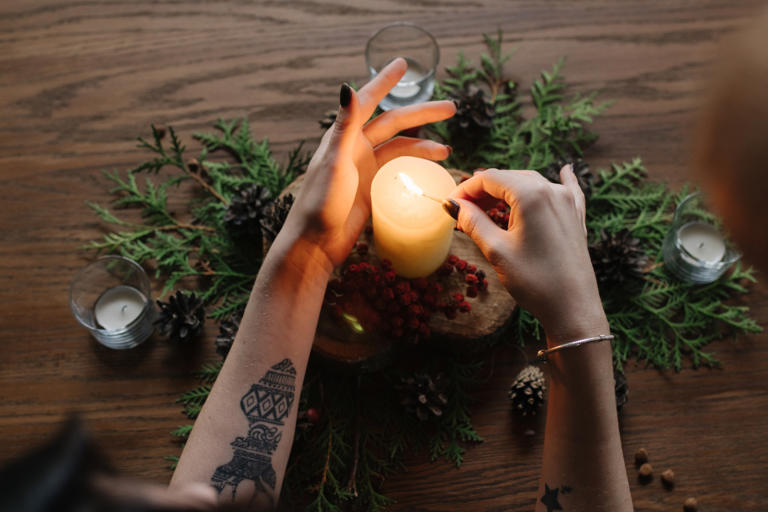
Fall Equinox rituals© Magnific.com
The Ancient Threshold of the Fall Equinox
Astronomically, the autumnal equinox occurs when the Sun crosses the celestial equator moving southward, marking the beginning of astronomical fall in the Northern Hemisphere and spring in the Southern Hemisphere.
The word “equinox” comes from Latin roots associated with “equal night,” referring to the near balance of daylight and darkness around this point in the year. Day and night are not perfectly equal everywhere because of atmospheric refraction and the way sunrise and sunset are measured, but the symbolism remains compelling. For a brief moment in the seasonal cycle, light and darkness appear to stand almost evenly beside one another before the nights gradually begin to lengthen across the Northern Hemisphere.
There is something inherently mystical about that balance, even without assigning anything supernatural to it. For thousands of years, humans have looked toward the sky to understand where they stood in the cycle of the year. Ancient monuments tracked the movement of the Sun. Harvest traditions honored what the land had produced. Communities understood that the changing light meant life itself was changing rhythm.
Before electric lights, central heating and grocery stores softened the practical consequences of the seasons, autumn required attention. Harvests were gathered, food preserved, fires prepared and resources carefully considered. The equinox was not simply another square on a calendar. It belonged to a larger rhythm of abundance and scarcity, activity and rest, light and darkness, life and decay.
That ancient rhythm still exists beneath our modern lives, whether or not we consciously follow it.
And perhaps that is why autumn can sometimes feel less like the arrival of another season and more like remembering something.
Summer Expands. Autumn Distills.
Summer encourages us to gather—experiences, plans, movement and possibility. Autumn offers a different wisdom, asking not what else we can add, but what is still meaningful enough to carry forward.
Nature makes this lesson visible. A tree does not cling to its leaves simply because they once nourished it; when their season is complete, it lets them fall. Perhaps we are meant to do something similar.
We often carry relationships, expectations, habits and old versions of ourselves long after they have served their purpose, partly because letting go can feel like admitting they never mattered. But something does not have to have been wrong to be finished. A relationship can have been meaningful and still need to change. A dream can once have guided us and no longer fit who we are becoming.
Autumn reminds us that release is not always rejection. Sometimes it is simply recognizing that a season has completed itself—and trusting ourselves enough to let it go.
The Turn Inward
There is a difference between withdrawing from life and returning to yourself.
The turn inward that autumn symbolizes is not about disappearing from the world. It is about allowing some of the energy that has been traveling outward to return home. As evenings lengthen and the pace of the natural world begins to soften, we are given an opportunity to notice what has been happening beneath the surface of our own lives.
Summer can make it remarkably easy to keep moving. Autumn often makes it easier to hear what movement has been drowning out.
Questions may begin surfacing that have no quick answers. Where has my energy been going? What have I been tolerating because I was too busy to examine it? What feels different now than it did at the beginning of summer? What have I outgrown without realizing it? What part of myself have I neglected while tending to everyone and everything around me?
The equinox does not require us to answer these questions immediately. Thresholds are not necessarily places of resolution. They are spaces between what has been and what has not yet fully arrived.
Sometimes it is enough simply to recognize that you are standing in one.
A Fall Equinox Threshold Ritual
There is something powerful about giving an invisible transition a physical form. This is one reason ritual has appeared across cultures and throughout human history: a simple action can help us mark what the calendar alone cannot.
For this autumn threshold ritual, gather two candles, a piece of paper and one small talisman that feels meaningful to you. It might be smoky quartz or another crystal, an acorn or fallen leaf found during a walk, a stone from somewhere important to you, or an heirloom connecting you to a person, place or chapter of your life that you want to remember as you move forward.
Place the two candles several feet apart, leaving enough space to walk comfortably between them. Once lit and safely positioned, allow the space between them to represent the threshold between seasons—and perhaps between two versions of your own life.
Before crossing, sit quietly with your paper and consider what you no longer want to carry in the same way.
Perhaps it is resentment that has occupied too much emotional space, an obligation accepted out of guilt, a fear that has been making decisions for you, an exhausting relationship dynamic, an impossible standard you keep asking yourself to meet or simply the belief that you must continually be productive in order for your life to have value.
Write whatever comes to mind without trying to make it sound beautiful.
Then take your talisman in your hand and stand before the space between the candles. Feel your feet against the floor. Take a slow breath and read what you have written aloud, not as a condemnation of the person who carried those things, but as an acknowledgment that you may no longer need to carry all of them into the season ahead.
Leave the paper behind you.
As you slowly cross between the candles, say:
“I release what has been.
I welcome what is becoming.
I step into the new season ahead with intention, openness and trust.”
Then remain on the other side for a moment.
There is no need to manufacture a revelation. Ritual is not magic in the sense that crossing between two candles will instantly dissolve grief, fear, complicated relationships or old patterns. Its power can be much quieter: you have created a moment in which you consciously acknowledged a transition that might otherwise have passed unnoticed.
Keep your talisman close throughout autumn. Place it beside your bed, carry it in a pocket, leave it on your desk or put it somewhere your eyes naturally fall. Over time, let it become associated not merely with what you chose to leave behind, but with what you decided was worth carrying forward—perhaps peace, courage, curiosity, stronger boundaries, creativity, tenderness, simplicity or greater trust in yourself.
Bringing the Season Into Your Home
Once the threshold has been crossed, the ritual does not necessarily have to end. Autumn can become something you practice slowly through the ordinary details of daily life.
Seasonal self-care is often presented as another collection of tasks—another routine to perfect, another checklist to complete—but autumn suggests almost the opposite. This is a season of editing. Instead of asking what else you should add to your life, consider what might make your life feel warmer, quieter and easier to inhabit.
Clear one small space that has accumulated clutter. Wash the blankets that have been tucked away since spring. Allow lamps and candles to replace some of the harsher evening light. Return to books, journaling, stretching, long walks, slow cooking or whatever practices make you feel more present inside your own life.
Herbs can become part of this sensory transition as well. Mugwort has long been associated symbolically with intuition and inner knowing, while rosemary carries associations with clarity and remembrance. Cinnamon evokes warmth, protection and comfort; sage is often connected with cleansing and clearing; and chrysanthemum has traditionally symbolized longevity in several cultural traditions.
You do not have to believe that an herb possesses a supernatural property to appreciate what it represents. Scent and symbolism have powerful relationships with memory. Rosemary rubbed beneath your fingers while cooking, cinnamon warming in the kitchen or dried herbs near a window can become small reminders to return to the intention you set at the threshold.
Eat With the Harvest
There is perhaps no more ancient autumn ritual than eating what the earth has produced.
Pumpkin, with its generous flesh and abundance of seeds, naturally evokes harvest, prosperity and fullness. Sweet potatoes grow hidden beneath the soil and can symbolize grounding and rootedness, while pears offer an image of softness and gentleness. The ruby-colored seeds of a pomegranate have carried associations with fertility, regeneration, death and rebirth across ancient mythology, making the fruit especially evocative during a season defined by transformation.
Mushrooms possess their own magical autumn mystery.
What we see emerging from damp earth is only the fruiting body of a much larger organism, much of which can exist hidden beneath the ground in networks of fungal threads. That unseen architecture makes mushrooms an especially fitting symbol for the inward season—a reminder that what is invisible is not necessarily inactive.
Some of the most important things growing within us may not yet be visible either.
A seasonal meal can honor that idea without becoming elaborate. Roast pumpkin or sweet potatoes with rosemary. Slice a ripe pear. Scatter pomegranate seeds across a dish. Cook mushrooms slowly and allow the kitchen to fill with their earthy scent.
Eating with the season becomes less about symbolism for symbolism’s sake and more about remembering that we are not entirely separate from the cycles occurring outside our windows.
Crystals for the Autumn Threshold
If crystals are part of your spiritual practice, autumn offers several whose traditional symbolism reflects the emotional landscape of the season.
Smoky quartz is associated with grounding and release, making it particularly fitting for something you are consciously leaving behind. Carnelian, with its warm orange and red tones, represents inner fire, creativity and courage—the flame we cultivate within as the external light diminishes.
Black tourmaline is commonly associated with protection and boundaries, while citrine carries symbolism around abundance, gratitude and optimism. Garnet, dark and jewel-like, has long been connected with vitality, passion and transformation.
Rather than collecting all of them, consider choosing one that represents what you most want to cultivate during the months ahead. It can become the talisman you carry through your threshold ritual, transforming an ordinary object into a private reminder of a promise made to yourself.
Its meaning comes not only from what tradition says the stone represents, but from what you decide it will remind you to remember.
The Harvest Is Not Always What We Expected
Autumn has always been a season of harvest, but there are years when what we gather looks very different from what we imagined planting.
But that does not mean there was no harvest.
Perhaps this year gave you stronger boundaries instead of the relationship you hoped would work. Maybe disappointment taught you discernment. Perhaps an ending returned a part of yourself that had been missing for years. Maybe you discovered that something you spent a long time pursuing was never truly yours to begin with.
There is room at the equinox for gratitude that does not pretend everything has been easy.
You can appreciate what a year has given you while acknowledging what it has taken. You can be grateful and exhausted, hopeful and uncertain, relieved and grieving. Human emotions do not have to arrive one at a time.
Perhaps the deeper harvest question is not simply, “What did I receive?”
It is, “What did this season reveal?”
Sometimes the harvest is abundance. Sometimes it is wisdom. Sometimes it is the uncomfortable clarity of finally knowing what you cannot carry anymore.
Reflections for the Season Ahead
As you move deeper into autumn, allow a few questions to accompany you without turning them into another assignment.
Consider what has grown in your life since the beginning of the year and what has quietly withered. Notice what you continue carrying simply because you have become accustomed to its weight. Think about where your energy has been going, which relationships restore you and which repeatedly leave you depleted.
Ask yourself what you are ready to stop proving, what deserves more of your attention and what might become possible if your life were allowed to become simpler.
There may also be something you are reluctant to release precisely because it once mattered so much. Autumn reminds us that honoring what something meant and allowing it to end are not opposites. Both can be acts of love.
And perhaps the most revealing question is the simplest: What would it feel like to enter the rest of this year carrying less?
You do not have to know the answer yet. Some questions are seeds rather than instructions. They need darkness, quiet and time before anything begins to emerge.
There Is a Season for Becoming—and a Season for Returning
Modern life constantly asks us to expand—to do more, achieve more, remain visible and keep moving. Nature follows a different rhythm. It blooms and releases, grows and rests, allowing entire landscapes to become bare while roots, seeds and mycelium continue their unseen work beneath the surface.
Perhaps that is autumn’s deeper mystery: not everything important needs to be visible while it is becoming.
The fall equinox stands between these worlds, reminding us that light and darkness belong to the same cycle. As autumn arrives, keep what nourishes you and loosen your grip on what has become heavy. Walk beneath changing trees, light a candle as evening falls, eat something grown from the earth and carry your chosen talisman as a reminder that even in quieter seasons, something within us may still be growing.
Follow me for more insights, spirituality, self-care and the quieter mysteries that connect our inner lives with the changing world around us.

